/prod01/channel_3/media/tcd/academic-services-division/images/banner/RPL-large.jpg)
TCD RPL Video Guide
This video provides a step-by-step guide to RPL: what it is, how to apply, and the next steps.
In assessing evidence of prior formal, non-formal and informal learning, the following criteria will be considered:
- Relevance - The evidence will be relevant to the course of study and correspond to the learning outcomes of the module(s) and to the broader programme-level outcomes.
- Level - The learning will be at the required level, i.e., it will map to the appropriate NFQ level descriptors.
- Sufficiency - The evidence in support of RPL will support the claim that the learning outcomes have been achieved.
- Reliability - The evidence of prior learning will be reliable, and it will be possible to verify that it is the learning of the applicant.
- Validity - The prior learning will match the required learning outcomes and will be demonstrated by valid mechanisms. These may include, but are not limited to, assessment procedures.
- Currency - The achieved prior learning will fit with current knowledge and practice.

The Five-Stage Process
All RPL processes require the applicant to provide evidence of appropriate past learning, whether that is certificated or experiential learning. In some cases, it may be sufficient for the applicant to provide copies of appropriate certificates.
In other cases, there may be a self-assessment exercise, preparation of a file or ‘portfolio’ of appropriate evidence of learning, an interview, and perhaps a demonstration or assessment task.
The process of RPL typically includes five stages: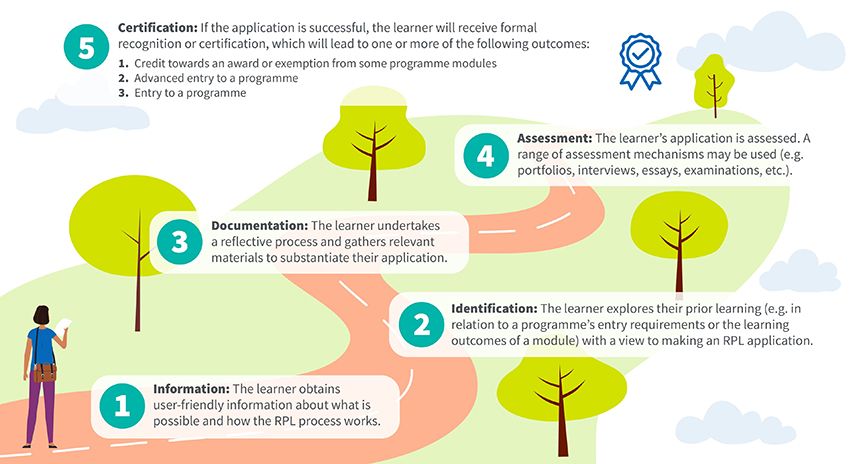
The learner obtains user-friendly information about what is possible and how the RPL process works.
The learner explores their prior learning (e.g. in relation to a programme’s entry requirements or the learning outcomes of a module) with a view to making an RPL application.
The learner undertakes a reflective process and gathers relevant materials to substantiate their application.
The learner’s application is assessed. A range of assessment mechanisms may be used (e.g. portfolios, interviews, essays, examinations, etc.).
If the application is successful, the learner will receive formal recognition or certification, which will lead to one or more of the following outcomes:
1. Credit towards an award or exemption from some programme modules,
2. Advanced entry to a programme,
3. Entry to a programme.