
Online M.Sc. in Managing Risk and System Change
Study Managing Risk and System Change Online
Applications for entry in September 2026 are NOW OPEN
Lead system change with confidence — study online, part-time, and apply what you learn at work.
A practice-led online MSc (90 ECTS) for professionals who design, manage and safeguard complex systems.
Applications for the September 2026 intake are NOW OPEN.
| Course Director: | Prof. Siobhán Corrigan |
| Course Queries: | Email: managingrisk@tcd.ie |
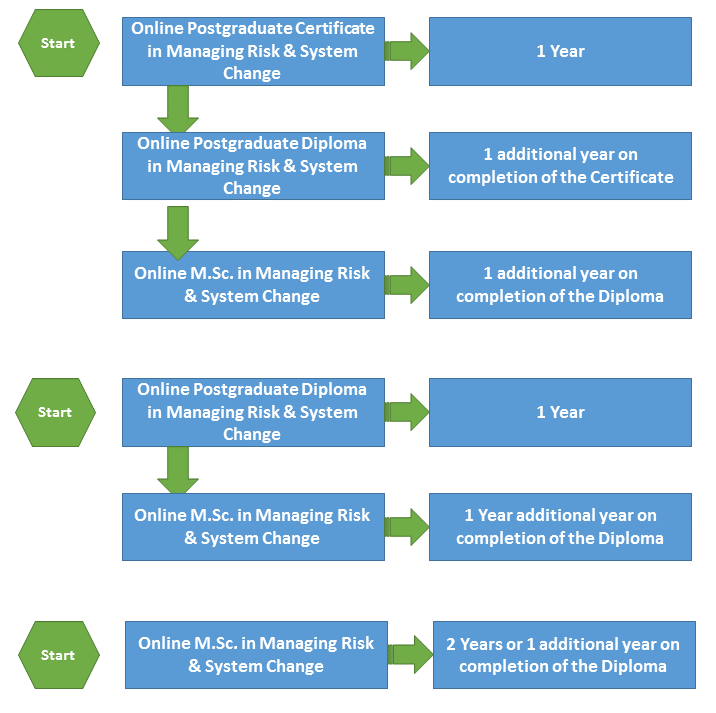
| Course Duration: | M.Sc. (2 or 3 years part-time) |
| Closing date for Applications: | 31st July 2026 |
| Next Intake: | September 2026 |
| ECTS Credits: | M.Sc. (90) |
| Course Code: | PTPS-MRSC-1O |
Overview of the Course
Turn frontline problems into research-backed solutions
This online MSc blends human-centred design, risk science and organisational change so you can lead improvements that actually stick. Built around real workplace projects, the course connects you with world-class academics and an international community of practitioners — all delivered with flexible online teaching that fits around a full-time job.
Students will also become part of a global community of practice, a community of professional learners, across a range of safety-critical sectors, where they will benefit not only from the academic and industrial experts delivering the course but also from the extended network of fellow students.
Read what some of our current and past students have said about the course in the testimonials section below.
Work-friendly, Structured Online Learning
Weekly learning materials, live evening lectures (typical Year 1 evenings: Tuesdays and some Thursdays 17:30–19:30 GMT) and an active virtual learning environment let you network with peers in real time or catch up via recorded sessions. The course is designed so every assignment has workplace value — no on-campus requirement for routine delivery.
Year One
| Semester 1 - Michaelmas Term | Semester 2 - Hilary Term | Semester 2 - Trinity Term |
|---|---|---|
| The Role of People & Processes in Organisations | Managing Performance | Leading Change |
| Stability & Change | Socio-Technical System Design | Strategic Human Resource Development |
| Statistics & Action Research Methods* | Statistics & Action Research Methods* | Statistics & Action Research Methods* |
*This module runs across all three semesters in year 1 of the course.
Year Two
In year two or three (pending the progression route) of the course students will pursue their research dissertation.
Complete four core modules across the academic year (Michaelmas, Hilary, Trinity terms). Finish the Certificate and you can add three more modules next year to upgrade to the Postgraduate Diploma — a clear route to the full MSc.
Ideal candidates:
-
Mid-career professionals responsible for risk, safety, change, operations, quality, HR or system design.
-
Practitioners from healthcare, aviation, defence, IT, finance, emergency services, pharma, manufacturing and regulated sectors.
-
Professionals who need practical tools and evidence to lead system change while remaining in full-time roles. Trinity College Dublin
Why it works for busy people:
Flexible online delivery, workplace-based assessments and evening sessions let you learn on the job — producing outputs that benefit your employer as you study.
I typically work evenings and weekends, so I need to be able to log on to Blackboard when it suits me. This course affords me the required flexibility to attain this qualification.Online Managing Risk and Systems Change Student
-
PS7501 — The Role of People & Processes in Organisations (10 ECTS)
Map real workflows and human interactions so you can redesign processes that increase value and reduce failure. -
PS7502 — Stability & Change (10 ECTS)
Learn why change programmes fail and build resilient strategies that embed improvements, not short-lived fixes. -
PS7503 — Managing Performance & Risk (10 ECTS)
Combine performance metrics with risk thinking to predict and prevent operational surprises. -
PS7504 — Socio-Technical System Design (10 ECTS)
Apply human-centred design to complex technical systems so new technology and processes fit people and practice. -
PS7505 — Leading Change (5 ECTS)
Develop pragmatic leadership tools to make business cases, resolve ethical dilemmas and build stakeholder support. -
PS7506 — Strategic HR Management (5 ECTS)
Align people strategy with operational needs to create the capability your organisation needs to change. -
PS7507 — Statistics & Action Research Methods (10 ECTS)
Master action-research and applied statistics to design, measure and validate workplace interventions. -
PS7508 — Dissertation (30 ECTS)
Deliver a workplace research project that solves a real organisational problem and produces publishable, practice-relevant findings.
Assessment is continuous and workplace-relevant: case reports, mini projects, reflective essays and professional dossiers. This approach builds an evidence portfolio you can show employers — theory tied to measurable operational outcomes.
See following sections for information on the dissertation.
Turn a real workplace problem into a research project that actually changes practice
In Year 2 (or Year 3, depending on your pathway) you’ll complete an action-based research dissertation that applies the concepts and skills from the taught modules to a tangible organisational challenge. This is your chance to deliver evidence-based change that matters — for your career and for your employer.
Purpose
The dissertation’s primary aim is to convert your critical understanding of people, processes and systems into a rigorous, practice-focused research project that delivers measurable outcomes in the workplace.
What you’ll do
-
Choose a topic that matters to you and your organisation (agreed with your academic supervisor and, where relevant, your host employer).
-
Design and deliver an action-based study that tackles a strategically important operational problem.
-
Produce a defended dissertation that demonstrates both theoretical insight and practical impact.
Learning objectives (what the dissertation builds)
-
Develop research-practitioner capability: design workplace research that drives improvement.
-
Apply theory to practice: use concepts learned on the course to frame and solve operational problems.
-
Contribute to knowledge: produce findings that add to the interdisciplinary evidence base on managing change and innovation.
Standards & expectations
You are expected to pose questions that are both theoretically meaningful and operationally useful, select methods that fit those questions, and apply analyses appropriate to the data you collect. High-quality dissertations are theory-driven, focused on a strategic operational challenge, and demonstrate clear contribution to scientific and practice-relevant knowledge.
What success looks like (practical outcomes)
-
A workplace intervention or improvement with documented impact.
-
A robust dissertation that employers recognise as valuable evidence of capability.
-
Research outputs suitable for dissemination (internal reports, conference papers or journal submissions) where appropriate.
Support & supervision
You’ll be assigned an academic supervisor who will guide your research design, methods and writing. Where applicable, engagement with a host organisation and an internal sponsor will strengthen access to data, facilitate implementation, and increase the likelihood of real-world impact.
Students receive a full handbook covering regulations, key dates and assessments, plus academic and technical support to make online study run smoothly around work.
Copies are made available to students as part of the registration and welcome process.
Who we’re looking for & flexibility for experienced hires
Typical applicants hold an honours degree (2.1 or equivalent) with 3–4 years’ relevant experience and access to a workplace for applied research.
Exceptional experienced candidates may be considered via the recognition of prior learning route; applicants might also be asked for writing samples or a short interview.
Full Entry Criteria:
- Applicants will normally be required to hold an Honours degree (II.1)** or equivalent and have at least 3 to 4 years appropriate professional experience.
- Applicants will also have to be in (or have access) to an employment setting that facilitates the applicant to be able to satisfy the applied research aspect of the course.
- **Note: In exceptional circumstances, the course director shall make appropriate recommendations to the Dean of Graduate Studies for candidates who do not fully meet the above criteria but make a reasonable case for admissions otherwise i.e. based on their work experience. An applicant may be asked to provide written samples in support of academic writing ability or be set a piece of academic writing to complete.
- Students whose first language is not English are required to provide official evidence of proficiency in the English language. Applicants to this course are required to meet Band B (Standard Entry)English language requirements. For more details of qualifications that meet Band B, see the English Language Requirements page.
- Applicants may also be asked to take part in a short interview (in person or via phone/skype) as part of the assessment process.
- References: students are requested to submit the names of two referees on their application form. In the first instance our preference is for one academic and one professional reference. We do however have discretion to accept either two academic or two professional references. Note: the referees listed on the application are automatically emailed a secure link to complete and upload the reference. Any difficulties in relation to references should be brought to the attention of the course administrator.
Applications are reviewed as received.
Submit the online form plus a CV, transcripts and two referees; the application fee is €55.
Applications close on 31st July 2026, so early completion improves your chance of an offer.
See Trinity’s Fees & Payments pages for current fee details and EU/non-EU guidance.
Many students secure employer sponsorship — ask us for a funding checklist and an employer-friendly application template. All fees are subject to annual review.
We asked some of our current and past students what they thought of our Online Masters in Managing Risk and System Change.
Thomas Chitseko - Graduate
'The world that we now navigate is fast-moving, complex, and interconnected. This means that when things go wrong, they can go very wrong indeed. Risk management professionals are responsible for perceiving the dangers in organisational systems and taking action to keep them running smoothly and safely. But 'risk' is a slippery concept and effecting organisational change is notoriously difficult. That is where the TCD MSc in Managing Risk and System Change comes in. This course is an audacious effort to combine expertise from across the spectrum of safety-critical industries to both improve practitioners' thinking about risk and to equip them with the tools that they need to make positive change within their organisations. While the scope of the subject matter is far too broad to be fully captured in a 2-year degree, the course teaches concepts and skills that help students to understand the problems of their own organisational contexts and then to engineer solutions to these problems. While some of these concepts are abstract, the emphasis of the course is relentlessly pragmatic and the constant challenge to students is to develop better understanding to enable and inform better, safer operations. I personally have benefited enormously from the development of my thinking that occurred during my study with TCD as I have made the transition from sea-going naval officer to shore-based maritime risk consultant, and I'm sure that the impact of my 2 years' study with Nick, Siobhan and the team will continue to resonate for the rest of my career.
Colette Kelly – Graduate
“I expected an amazing standard of education and I was not disappointed. The factor, however, that motivated me to attain a level of conceptual change, that translated the acquisition of information into a new way of thinking and a new perspective on how I perceive the world, was the ethos of encouragement, genuine interest and belonging I experienced through every contact with the lecturers and the support team. My lecturers facilitated an expansive learning experience; my supervisors lifted spirits and curtailed effusive prose throughout a tumultuous period of thesis preparation and writing, the support team reassured with an enthusiasm that was infectious at crisis points.
My M.Sc. in Risk Management and System Change course was delivered online, with regular onsite events occurring across two years. The creativity with which the course team designed and delivered the course ensured that a diverse group of students, located world-wide, bonded in a manner that is a testament to the holistic quality of a Trinity education.
I made life-long friends. From the initial enquiry through to graduation and beyond, the level of support and care offered continues to inspire and surprise me.”
Gavin Curran - Graduate  “The Masters in Managing Risk and Systems Change provides an excellent opportunity to learn from both a theoretical and practical stance, about the key ingredients for successful system change and risk mitigation. A particular highlight of this course involves the interaction with students from a variety of backgrounds, each with different industry experiences and knowledge.
The lecturers facilitate an open and highly respectful atmosphere and encourage all students to work together and share their knowledge. The content covered is insightful and its delivery is highly professional and accessible. The flexibility of attending and completing this course online makes it a realistic achievement for those willing to take up the challenge.”
Niall Ferns – Graduate
“I am certain that the delivery of third level on-line courses will prove to be a major step forward in the education of students. In particular, the delivery of the MSc in System Design and Risk has been very beneficial for me. I typically work evenings and weekends so I need to be able to log on to Blackboard when it suits me. This course affords me the required flexibility to attain this qualification.
The on-line sessions are an important feature of the course. The notes are well presented, informative and easily understood and provides for excellent interaction between the students. At all times the supervisors and tutors are available whether to clarify any issues or to offer guidance on the course.
The weekly work and module assignments are challenging so it is important to manage your time to ensure that you are up to date. Overall, I have found the course stimulating and the interaction with the fellow students has been a major factor in the success of the course. I would highly recommend this on-line course to prospective students”
Sean O ‘Hara – Graduate
“ TCD's Online M.Sc in Managing Risk & System Change has been a fantastic mechanism for acquiring knowledge.
For those of us who work full time and could not therefore contemplate attending a conventional degree course on either a full or part time basis, this innovative approach has resulted in a highly flexible and adaptable course, carefully structured for all students of all ages (56yrs in my case),
I have enjoyed the huge academic challenge and the interaction with practitioners from a wide range of industries has been most enlightening. Having spent over 35 years in the aviation industry, this course is evidence that it's really never too late to learn!
Suffice to say that the 'comfort zone' will never be the same again”
David Browne – Graduate
“I completed the MSc in Managing Risk and System Change through the School of Psychology in 2017. The excellent course vastly expanded my academic horizons and took me along exciting new pathways of learning that were unknown to me prior to commencing the course. The knowledge I gained through both online lectures and directed research has equipped me to think and work in my operational environment using the very latest concepts and innovative approaches to risk management and system change in a high risk operational setting.
The course was delivered by world-class subject matter experts, the academic resources available in the university were second to none (and continue to be as alumni) and the administrative support was excellent. As the course was delivered using an online platform, I could join the virtual classroom from anywhere in the world and interact at times that suited me, which afforded me huge flexibility in engaging with all course content. I would highly recommend the course to anyone thinking about progressing their academic knowledge in safety, risk and change, and to anyone seeking to better equip themselves in the workplace in the management of these critical areas.”
Finola Cashman - Graduate
“I am a non-traditional student. I work full-time with the H.S.E., and have been out of academia for over 15 years. I applied to the M.Sc. in Managing Risk and Systems Change because it was so relevant to what I do. It has been a wonderful opportunity and a great learning experience for me. My understanding and views on managing risk and systems change in socio-technical systems, such as healthcare, have been considerably broadened by what I have learned.
This programme is both exciting and genuinely hard work. The course modules are packed with information and are fast-paced. The assignments encapsulate real-life problems and require real-life response times. The quality and volume of course material provided are excellent. The TCD library is in one word, impressive, and truly accessible to a novice researcher like me with the invaluable assistance provided by the librarians.
As this course is delivered on-line it provided me with the flexibility needed to manage my career, be available to my family, and incorporate a challenging course of study. On-line learning, while making this course possible for me to study and work full time, it can also be isolating but the lecturers and tutors are exceptionally responsive and support me by making themselves available during times that fit my busy schedule. This course is definitely worth the time and effort.”
Attend an online information evening to meet staff, see Blackboard, review the timetable and ask about assessments and fees. Dates for the next sessions will be posted in early 2026.
Typical Open Evening Structure
- Course Structure
- Student Learning Software Demonstration (Backboard)
- Is This Course For You
- Timetable
- Assessments
- Entry Requirements
- Tuition Costs
For admissions, suitability, or employer funding questions, email the course administrator and attach your CV for a quick suitability check.
| Mr. Rory Carrick Course Administrator managingrisk@tcd.ie +353-1-896-4818 |
Professor. Siobhán Corrigan Course Director siobhan.corrigan@tcd.ie +353-1-896-2605 |
Professor Nick Mc Donald Academic Programme Development nmcdonald@tcd.ie +353-1-896-1471 |