
Online Postgraduate Certificate in Managing Risk and System Change
Study Managing Risk and System Change Online
Applications for entry in September 2026 are NOW OPEN
Upskill in-system: learn practical risk, safety and change methods while you work.
One-year, part-time online study for professionals who design, lead or operate critical systems.
Next intake September 2026.
| Course Director: | Prof. Siobhán Corrigan |
| Course Queries: | Email: managingrisk@tcd.ie |
| Course Duration: | Postgraduate Certificate (1 year part-time) |
| Next Intake: | September 2026 |
| ECTS Credits: | P.Grad. Certificate (30) |
| Course Code: | DPCPS-MRSC-1O |
Overview of the Course
This 1-year Postgraduate Certificate (30 ECTS) takes four modules from our established M.Sc., delivering industry-tested frameworks for managing risk, people and systems. It’s built for professionals in safety-critical and regulated sectors who need practical methods they can apply straight away.
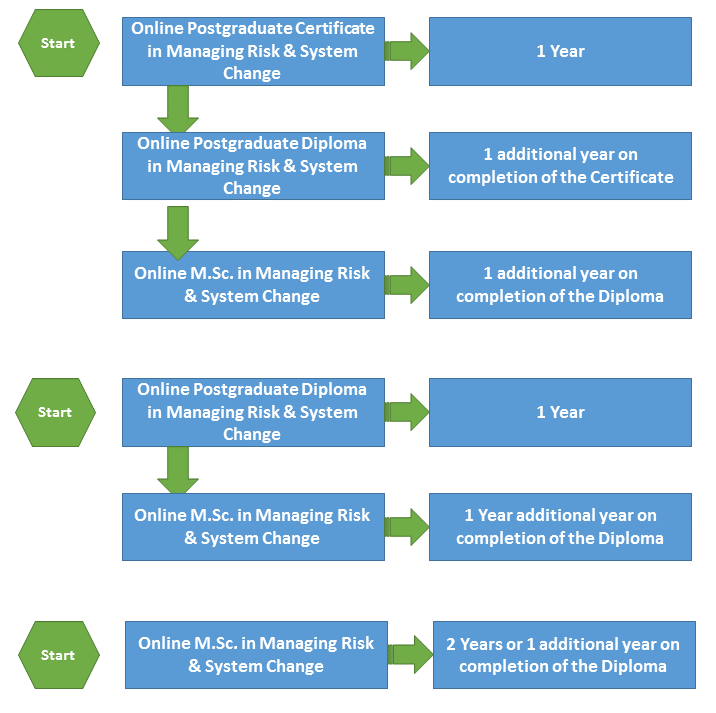
Finish the Certificate and you’ll be able to top up to the Postgraduate Diploma in a subsequent year.
All teaching is online and structured for working professionals: weekly materials, evening lectures (typically Tuesdays 17:30–19:30 GMT), discussion boards and recorded sessions you can watch anytime.
The course blends short lectures with applied activities so your assignments produce real improvements at work.
| Semester 1 - Michaelmas Term | Semester 2 - Hilary Term | Semester 2 - Trinity Term |
|---|---|---|
| The Role of People and Processes in Organisations | Managing Performance and Risk | Leading Change |
| Strategic Human Resource Development |
Complete four core modules across the academic year (Michaelmas, Hilary, Trinity terms). Finish the Certificate and you can add three more modules next year to upgrade to the Postgraduate Diploma — a clear route to the full MSc.
Ideal candidates:
-
Mid-career professionals responsible for risk, safety, change, operations, quality, HR or system design.
-
Practitioners from healthcare, aviation, defence, IT, finance, emergency services, pharma, manufacturing and regulated sectors.
-
Professionals who need practical tools and evidence to lead system change while remaining in full-time roles. Trinity College Dublin
Why it works for busy people:
Flexible online delivery, workplace-based assessments and evening sessions let you learn on the job — producing outputs that benefit your employer as you study.
I typically work evenings and weekends, so I need to be able to log on to Blackboard when it suits me. This course affords me the required flexibility to attain this qualification.Online Managing Risk and Systems Change Student
Assessment is continuous and workplace-focused: case reports, mini-projects, reflective essays, blogs and professional dossiers. The emphasis is on producing work you can use — a portfolio that shows employers the impact of your learning in real time.
-
PS7501 — The Role of People & Processes in Organisations (10 ECTS)
Learn to map real work, identify how people and information shape outcomes, and redesign processes that actually deliver value. -
PS7503 — Managing Performance & Risk (10 ECTS)
Turn risk analysis into performance gains: set actionable indicators, diagnose failure modes, and reduce surprises in complex systems. -
PS7505 — Leading Change (5 ECTS)
Develop the leadership toolkit to build business cases, manage ethical dilemmas, and guide teams through risky change with confidence. -
PS7506 — Strategic HR Management (5 ECTS)
Align HR strategy with operations so your organisation has the skills and resilience to adapt and perform.
Students receive a full handbook covering regulations, key dates and assessments, plus academic and technical support to make online study run smoothly around work.
Copies are made available to students as part of the registration and welcome process.
Who we’re looking for & flexibility for experienced hires
Typical applicants hold an honours degree (2.1 or equivalent) with 3–4 years’ relevant experience and access to a workplace for applied research.
Exceptional experienced candidates may be considered via the recognition of prior learning route; applicants might also be asked for writing samples or a short interview.
Full Entry Criteria:
- Applicants will normally be required to hold an Honours degree (II.1)** or equivalent and have at least 3 to 4 years appropriate professional experience.
- Applicants will also have to be in (or have access) to an employment setting that facilitates the applicant to be able to satisfy the applied research aspect of the course.
- **Note: In exceptional circumstances, the course director shall make appropriate recommendations to the Dean of Graduate Studies for candidates who do not fully meet the above criteria but make a reasonable case for admissions otherwise i.e. based on their work experience. An applicant may be asked to provide written samples in support of academic writing ability or be set a piece of academic writing to complete.
- Students whose first language is not English are required to provide official evidence of proficiency in the English language. Applicants to this course are required to meet Band B (Standard Entry)English language requirements. For more details of qualifications that meet Band B, see the English Language Requirements page.
- Applicants may also be asked to take part in a short interview (in person or via phone/skype) as part of the assessment process.
- References: students are requested to submit the names of two referees on their application form. In the first instance our preference is for one academic and one professional reference. We do however have discretion to accept either two academic or two professional references. Note: the referees listed on the application are automatically emailed a secure link to complete and upload the reference. Any difficulties in relation to references should be brought to the attention of the course administrator.
Apply Early for a Quick Decision
Applications are reviewed as received.
Submit the online form plus a CV, transcripts and two referees; the application fee is €55.
Applications close on 31st July 2026, so early completion improves your chance of an offer
See Trinity’s Fees & Payments pages for current fee details and EU/non-EU guidance.
Many students secure employer sponsorship — ask us for a funding checklist and an employer-friendly application template. All fees are subject to annual review.
Postgraduate Certificate Graduates:
Students who have already successfully completed the Postgraduate Certificate can return to complete a further three modules and upgrade their qualification to a Postgraduate Diploma. Please contact the course administrator for details on the application procedure.
Attend an online information evening to meet staff, see Blackboard, review the timetable and ask about assessments and fees. Dates for the next sessions will be posted in early 2026.
Typical Open Evening Structure
- Course Structure
- Student Learning Software Demonstration (Backboard)
- Is This Course For You
- Timetable
- Assessments
- Entry Requirements
- Tuition Costs
For admissions, suitability, or employer funding questions, email the course administrator and attach your CV for a quick suitability check.
| Mr. Rory Carrick Course Administrator managingrisk@tcd.ie +353-1-896-4818 |
Professor. Siobhán Corrigan Course Director siobhan.corrigan@tcd.ie +353-1-896-2605 |
Professor Nick Mc Donald Academic Programme Development nmcdonald@tcd.ie +353-1-896-1471 |