
Resolving ambivalence between EAT Lancet and Irish Healthy Eating Guidelines
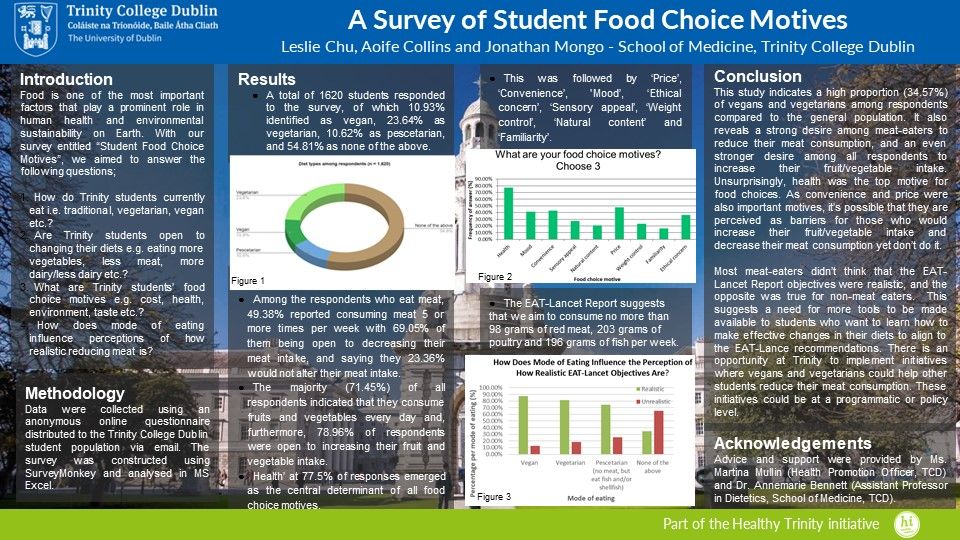
Thanks to the students and staff who completed our food choice motives survey in April 2022. Summary below. Trinity has a high proportion of vegans, and vegetarians, relative to the national population and there's a strong desire among meat eaters to reduce their meat consumption. Amongst all respondents, there's an even stronger desire to increase their fruit/vegetable intake.
Unsurprisingly, health was the top motive for food choices. This student led study suggests a need for more tools to be made available to students who want to learn how to make effective changes in their diets to align to the EAT-Lance recommendations.
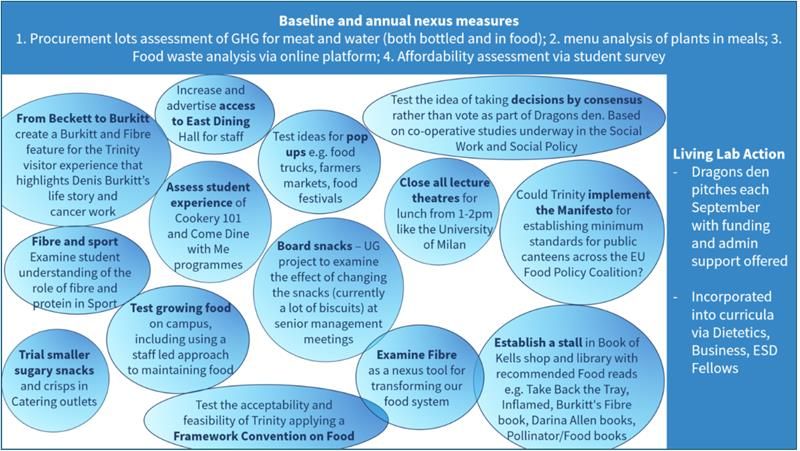
Living Lab Ideas
The Living Lab structure aims to harness the interest and ideas of the Trinity community and to enable change on campus.
/prod01/channel_3/media/tcd/healthy-trinity/images/Living-Lab-Ideas.jpg)
Trinity students and staff are very interested in food and people often have food ideas they would like to see implemented on campus. Examples of ideas that have been brought to the Food group while writing this plan are shown right. A Living Lab structure with baseline and annual nexus measures and Living Lab events will be implemented to harness the ideas and energy of Trinity students and staff.
Glossary of terms
Glossary of terms
|
Term |
Description |
Source |
|
Community supported agriculture (CSA) |
The CSA model involves consumers – often termed ‘shareholders’ – subscribing to a weekly (or other set interval) share of a farm’s harvest. CSA farmers can estimate their potential sales and costs each year prior to the growing season. This baseline knowledge and pre-harvest subscription capital can aid in decisions on whether to diversify market channels, scale-up production in selected vegetable varieties, and/or pursue certifications (e.g. food safety or organic). |
Rossi and Woods, (2025) |
|
Short-food supply chains (SFSC) |
SFSCs comprise a wide diversity of market-based initiatives, including on-farm direct sales, community-supported agriculture (CSA), farmers’ markets, farmer shops, direct farmer-to-retailer, artisan, canteen or restaurant procurement schemes as well as digital platforms proposing well-identified farmers’ products [3,4] |
Chiffoleau and Dourian, (2020) |
|
Agroecology |
Agroecology encompasses a broad spectrum of agricultural practices based on ecological principles like building life in the soil, recycling nutrients, the dynamic management of biodiversity and energy conservation at all scales. Agroecological farming is embedded and adapted to the ecosystems, communities, and soils of the places where it is practiced, incorporating a social and geographical element which makes Agroecology different according to people and place. Permaculture, Regenerative farming, Agroforestry, Organics and Biological farming can all be considered part of the broad family of Agroecological land use practices. |
Tallamh Beo, (2021) |
|
Person-centred |
Being person-centred means a whole system approach to health and social care that values people, innovation, learning and teamwork throughout the organisation and demonstrates appreciation and respect for the unique contribution that people make regardless of position or status. |
HSE (2016), Health Foundation (2016) |
|
Nexus measures |
"Nexus" is a perspective that emphasizes the inter-relatedness and interdependencies of ecosystem components and human uses, and their dynamics and fluxes across spatial scales and between compartments. For the purpose of this Plan, nexus measures are the indicators that will be used to measure progress towards the Plan’s targets under Living Lab. |
|
|
Food citizen |
The term food citizenship is defined as the practice of engaging in food-related behaviours that support, rather than threaten the development of a democratic, socially and economically just, and environmentally sustainable food system. |
Wilkins (2005), Bindi and Belliggianno (2023) |
|
Plants first approach |
The plants first approach normalises plant-based meals by making plant-based food the default. Morgenstern et al (2024) describes how NYC Health+ Hospitals have implemented a plants first nutrition program making plant-based meals the primary lunch and dinner options for patients at its 11 hospitals. Patient acceptance was over 95% and patient satisfaction above 90%. Per-tray food costs for plant-based mains cost $0.59 less compared to trays including animal products. Furthermore, the hospital system achieved a 36% reduction in calculated carbon emissions as a result of their plant-first approach. |
Not defined in literature. |
|
Plant-based |
A diet that revolves around plant foods such as fruits, vegetables, legumes, nuts, grains and seeds. This diet excludes all animal products and byproducts; however a person who follows a plant-based diet is not automatically a vegan. At the same time, a vegan is not automatically whole food plant-based either, as a vegan could eat vegan-friendly sweets and cookies, but a whole food plant-based diet stays away from processed foods. There is a clear need for guidance on the term ‘plant-based’ in particular. For most consumers, particularly those not familiar with more plant-based wholefoods, perceptions that plant-based diets are another fad diet, associated with vegan and vegetarian diets, and with a commercialised industry containing many highly processed foods, appear to be prevalent. The distinction made between traditional vegetarian diets containing plant-based wholefoods such as legumes, versus new vegetarian diets which were considered by some to be highly processed, is an important one that can be used to raise more awareness of plant-based wholefoods. More details in Appendix A. Pulse survey of student understanding of plant-based here.
The proposed definition for a plant-based diet was “a dietary pattern in which foods of animal origin are totally or mostly excluded”. Other types of diets, such as flexitarian and pescetarian diets, could be considered plant-based. |
Safe food (2023)
Safe food (2023)
Hargreaves et al (2023) |
|
Plant-predominant |
Vegan, vegetarian, plant-based whole food diets are bundled as plant-predominant in this systematic review. The same review implies “usual” diets are the standard western diet and refers to standard health-oriented diets such as the American Heart Association (AHA), American Diabetic Association (ADA), and Mediterranean diets. |
Remde et al (2021) |
|
Local |
Food grown on the island of Ireland is the definition of local for this Plan. Brune et al (2023) propose defining local food using the specific locality where food is produced (e.g., county or state) as opposed to defining local food in terms of distance. They suggest a locality-based definition as a pragmatic response to overcoming disputed definitions of local amongst activists, governmental entities, and researchers. |
Brune et al (2023) Chicoine et al (2022) |
|
Neoliberalism |
Neoliberalism refers to a political-economic philosophy and set of practices that prioritize market mechanisms, deregulation, and privatisation, often leading to reduced state intervention in economic and social affairs. It fundamentally reshapes economies, societies and environments through the marketisation of public services, strategic state restructuring, and processes of uneven development. The term itself has remained largely invisible within Irish political and economic life. In contrast to the UK or the US, Ireland's initial path towards neoliberalism did not involve a torturous dismantling of the welfare state or contentious battles with trade unions. Neoliberal transformations were rather folded into a commonsense and consensual approach to policy formation that temporarily blunted their sharper edges, allowing the path towards a deregulated and “open” economy to appear both pragmatic and (almost) universally beneficial to the population. |
MacLeavy (2025)
|
|
Wellbeing Framework |
Ireland’s cross-government Well-being Framework brings economic, societal and environmental impacts together under one Framework placing a particular focus on equality and sustaining well-being into the future. It includes 11 dimensions of well-being, which capture the areas that matter most to the people of Ireland for a good quality of life - areas such as housing, skills, work, health and community. |
Government of Ireland (2025) |
|
Vegan |
A person who doesn’t eat or use any animal products and commits to a lifestyle that is devoted to animal rights. Veganism has specific ethical and political beliefs that encourages people to abstain from buying, wearing or using animal products of any kind. |
Safe food (2023) |
|
Vegetarian |
A vegetarian diet should be defined as “a dietary pattern that excludes meat, meat-derived foods, and, to different extents, other animal products”. This review of literature suggests that definition would include, among others, ovolactovegetarian and vegan diets. A vegetarian diet should not be considered restrictive. Instead, terms such as alternative or non-conventional could be used to define it and to distinguish it from the conventional diet adopted by most of the Western population. |
Hargreaves et al (2023) |
Health and Wellness Practices - Undergraduates
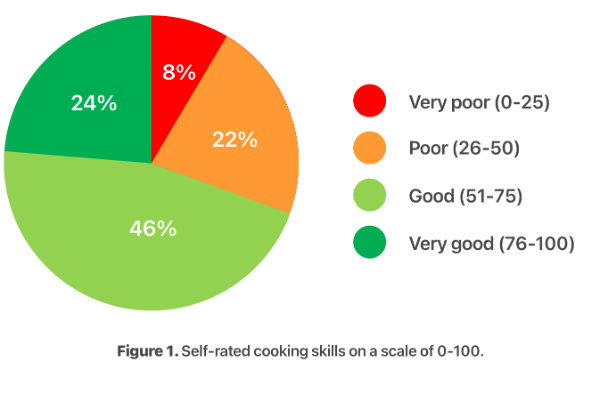 In April 2019, a web-based survey was emailed to all Trinity undergraduate students. 1458 responded. Details here.
- 28% (n408) rated their cooking skills as ‘poor’ or ‘very poor’ (Fig. 1).
- Two in five (40.6%, n592) used a screen at least once a day during a meal.
- 72.5% (n1057) reported that college commitments most commonly overtake time initially set aside for cooking.
- Elements of the physical environment most commonly contributed to a positive eating environment
The study concluded:
- There is a need to address the suboptimal practical food preparation skills, self-management and time-management skills of undergraduate students.
- It is recommended that a study identifying the characteristics of students who are more likely to report suboptimal health behaviours and inadequate skills is conducted.
Health and Wellness Practices – Postgraduates and Staff
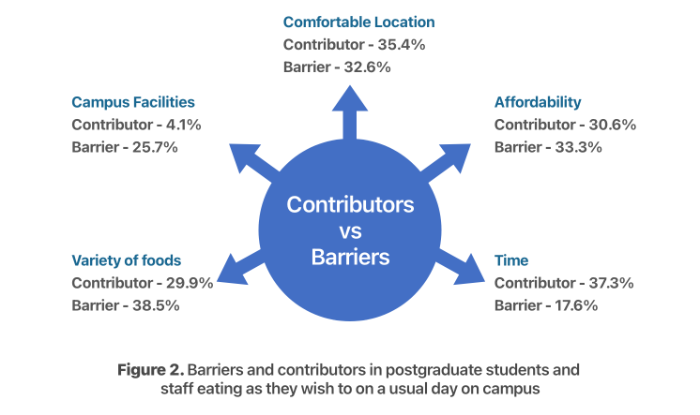 In April 2019, a web-based survey was emailed to all Trinity postgraduates and staff. 579 responded. Details here.
- A quarter (24.8%) of the total sample reported that a usual day in work rarely or never enabled them to eat the way they wish to
- Barriers to enabling participants to eat as they wish to included a perceived lack of: campus facilities, variety of foods available, and time (Fig. 2)
- Importance of healthy eating was rated 65.9 ±20.9 on a scale of 0-100 (p=0.396)
- Cooking skills were rated an average of 65.7 ±21.0 on a scale of 0-100 (p=0.789)
- One in ten (11.6%) cooked with fresh ingredients less than once a week, with PG students less likely to cook with fresh ingredients (p=0.034)
- A majority (83.5%) ate while using a screen some, most, or every day (p=0.066)
The study concluded:
- Many of the perceived barriers to healthy eating were common for postgraduate students and staff
- Despite self-reporting moderate levels of cooking skills, the majority of participants do not cook with fresh ingredients every day
- Key issues that impede cooking and healthy eating were affordability of food and poor time-management
- University-based interventions aimed at improving food preparation skills, time management skills relating to food preparation, and self-efficacy skills should be explored
Eating Habits of Trinity Undergraduates
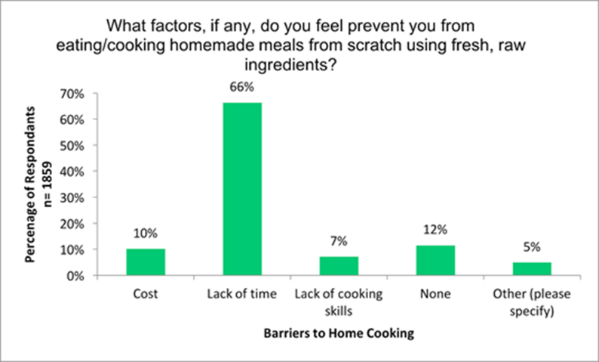
In 2017, Trinity medical students in partnership with Healthy Trinity undertook a survey of student eating habits that incorporated the Healthy Ireland IPSOS MRBI survey which was published in 2015. An abstract of their findings is below.
Introduction: Diet and smoking are two lifestyle factors that play a key role in determining one’s health and risk factors for morbidity. The aims of this study were to survey the eating and smoking habits of Trinity College undergraduate students and compare them to national statistics.
Method: Data were collected using an anonymous online questionnaire, distributed via email to the Trinity undergraduate population.
Results: 1,910 undergraduates responded to the survey. Trinity students appear to have a healthy diet when compared to national figures, consuming more fruit and vegetables and less snack portions and sugar-sweetened drinks than the rest of the population. Lack of time was identified as the main barrier to healthy eating among students.
Conclusion: Trinity students have healthier eating and smoking habits than the general population. Students are vulnerable to developing poor eating and lifestyle habits during the transition to college, therefore, it is important that the college is aware of its students’ current eating and smoking habits, in order to implement more effective intervention campaigns specific to its student population. A key target area identified by this study is student time management as a barrier to healthy eating.
This research was completed by medical students Aoife Doyle, Daire Pryal and Lorna Mooney with supervision by Martina Mullin (College Health Service) and Dr. Catherine Hayes (School of Medicine) and support from Dr. David McGrath (Director of College Health Service), Prof. Joseph Harbison (School of Medicine) and Dr. Aileen Patterson (Head and Deputy Head of Undergraduate Teaching and Learning in School of Medicine, respectively)