
Programme details
Postgraduate Taught Programme: Applied Intercultural Communications
/prod01/channel_3/media/tcd/langs-lits-cultures/images/Intercultural-Communications-Banner-860X35.png)
Our programmes combine core modules in intercultural communication with optional modules catering for different interests and skill needs, from digital literacy to international negotiation. Our courses are designed as both stand-alone and linked courses through the top-up progression, allowing both full-time and part-time study and offering module options that suit your interests.
Through the PGCert, students gain an understanding of the main concepts and models related to intercultural communication and learn how to apply Equality, Equity, Diversity and Inclusion (EEDI) perspectives and digital literacy to develop equitable collaborations and partnerships with people from different backgrounds.
These knowledge and skills are further developed in the PGDip by considering the role of communication across diverse languages and by learning how to use diverse media to communicate across cultures. Finally, the MPhil (Master's Degree) provides students with the opportunity of carrying out academic intercultural communication research in relation to a specific sector or discipline.
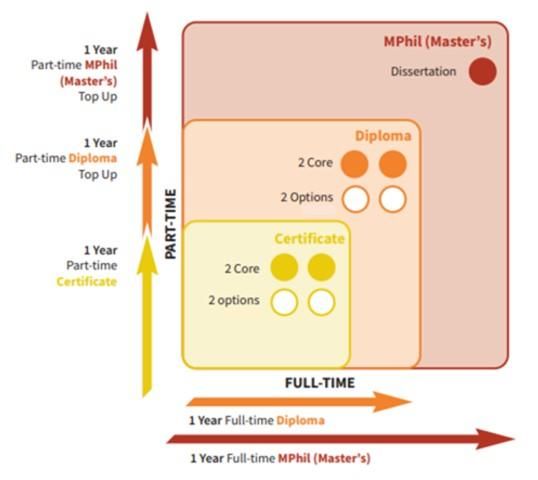
Summary view:
There will be three parallel points of entry for applicants to choose from and two progression routes:
- A direct entry to a one-year full-time Master’s Degree which will also offer an exit award of Postgraduate Diploma upon completion of 60 ECTS credits without completion of the Master’s dissertation.
- A direct entry to the one-year full-time Postgraduate Diploma. The postgraduate diploma delivered over one year will also enable progression to the Master’s top-up of 30 credits in year 2.
- A direct entry to a part-time Certificate, which can stand alone or can be followed by a Diploma top-up in year two and a Master’s top-up in year 3.
Detailed view:
- An entry point to a one-year full-time 90 ECTS credits Master’s programme leading to the MPhil degree, with the option of a Postgraduate Diploma exit award for those completing 60 ECTS credits without the Master’s dissertation. or
- An entry point to a 1 one-year full‐time Postgraduate Diploma (worth 60 ECTS credits) for holders of a Postgraduate Certificate, to be followed by progression to a top-up one-year part-time MPhil programme in year 2 (leading to the MPhil degree) for holders of the Postgraduate Diploma. or
- An entry point to a part‐time Postgraduate Certificate (with an attainment award) 30 ECTS credits to be followed by progression to a one-year part‐time Postgraduate Diploma top-up in year 2 (with an attainment award) for holders of the Postgraduate Certificate, with a possible further progression to the MPhil top-up in year 3 (with an attainment award).
The proposed course structure (options 1, 2 and 3) will make the MPhil a one-year full-time, two-year part-time or three-year part-time course respectively.
The stages on options 2 and 3 above can be completed consecutively without any interruption to the student’s study or may be completed with interruptions as students may collect their awards at each intermediate stage and return to the Master’s programme rescinding their award/s within the lifetime of the programme.
Core Modules
- ICP11001 Introduction to Intercultural Communication
- ICP11011 Communicating in a Culturally Diverse Workplace: A Practical Toolkit
- ICP11031 Language, Culture and Communication
- ICP11042 Multimodal Communication
Option Modules
(This list may vary year by year and some options may not be available every year)
- ICP11022 Reflective Learning Project on Intercultural Communication Practices
- ICP11051 Research Methods and Design
- ICP11061 Decoloniality and Global Intersections
- ICP11072 Feminism in Global Contexts: Intersections, Interpretations, and Impacts
- ICP11082 Communicating your Research through Reflective Narratives
- ICP11091 European Censorship and Cultural Production: Church, State and Ideas of the Common Good
- ICP11102 European Censorship and Cultural Production: From Clandestine Printing into the Digital Era
- DHP11012 Cultural Technical Systems
- ID7003 Cultures of Memory and Identity in Central Europe
- ID7010 Europe and Its Identities: A Cultural History
- ID7011 Food, Drink and European Cultural Identities
- ID7019 Forced Migration and Identity: Reconstructed and Reimagined Futures
- LTP11032 Machine Translation for Creative Texts
- NMP11032 EAST and WEST
| Module Title | ECTS Credits | Core / Option | Semester |
|---|---|---|---|
| ICP11001 Introduction to Intercultural Communication (face to face) | 5 | Core | 1 |
| ICP11011 Communicating in a Culturally Diverse Workplace: A Practical Toolkit (face to face) | 5 | Core | 1 |
| ICP11031 Language, Culture and Communication (face to face) | 5 | Core | 1 |
| ICP11051 Research Methods and Design (online) | 10 | Option | 1 |
| ICP11061 Decoloniality and Global Intersections | 10 | Option | 1 |
| ICP11091 European Censorship and Cultural Production: Church, State and Ideas of the Common Good | 10 | Option | 1 |
| ID7003 Cultures of Memory and Identity in Central Europe | 10 | Option | 1 |
| ID7019 Forced Migration and Identity: Reconstructed and Reimagined Futures | 10 | Option | 1 |
| ICP11042 Multimodal Communication (face to face) | 5 | Core | 2 |
| ICP11022 Reflective Learning Project on Intercultural Communication Practices (online) | 10 | Option | 2 |
| ICP11072 Feminism in Global Contexts: Intersections, Interpretations, and Impacts |
10 | Option | 2 |
| ICP11082 Communicating Your Research Through Reflective Narratives | 10 | Option | 2 |
| ICP11102 European Censorship and Cultural Production: From Clandestine Printing into the Digital Era | 10 | Option | 2 |
| DHP11012 Cultural Technical Systems | 10 | Option | 2 |
| ID7010 Europe and Its Identities: A Cultural History | 10 | Option | 2 |
| ID7011 Food, Drink and European Cultural Identities | 10 | Option | 2 |
| NMP11032 EAST and WEST (online) | 10 | Option | 2 |
| LTP11032 Machine Translation for Creative Texts | 10 | Option | 2 |
| ICP11DIS Dissertation (non-taught module offering personal supervision arrangements) | 30 | Core | 3 |
Programme modules allocated to M.Phil./PgDip/PgCert courses:
M.Phil. (1-year full-time)
Students need to take 60 ECTS credits of taught modules in year 1 + Dissertation (worth 30 ECTS credits and due at the end of the summer) as follows:
- First Semester (Michaelmas Term) = ICP11001 and ICP11011 (5 credits each) + ICP11031 (5 credits) + two options to choose from ICP11051, ICP11061, ICP11091, ID7003, ID7019 (10 credits each) = 35 ECTS credits
- Second Semester (Hilary Term) = two options to choose from ICP11022, ICP11072, ICP11082, ICP11102, DHP11012, ID7010, ID7011, NMP11032, LTP11032 (10 credits each) + ICP11042 (5 credits) = 25 ECTS credits
- Thesis supervision: Hilary Term and Trinity Term (Thesis submission: end of the Research Term)
PGDip (1-year full-time)
Students need to take 60 ECTS credits of taught modules in year 1 as follows:
- First Semester (Michaelmas Term) = ICP11001 and ICP11011 (5 credits each) + ICP11031 (5 credits) + two options to choose from ICP11051, ICP11061, ICP11091, ID7003, ID7019 (10 credits each) = 35 ECTS credits
- Second Semester (Hilary Term) = two options to choose from ICP11022, ICP11072, ICP11082, ICP11102, DHP11012, ID7010, ID7011, NMP11032, LTP11032 (10 credits each) + ICP11042 (5 credits) = 25 ECTS credits
PGCert (1-year part-time)
Students need to take 30 ECTS credits of taught modules in year 1 as follows:
- First Semester (Michaelmas Term) = ICP11001 and ICP11011 (5 credits each)
- Second Semester (Hilary Term) = two options to choose from ICP11022, ICP11072, ICP11082, ICP11102, DHP11012, ID7010, ID7011, NMP11032, LTP11032 (10 credits each)
Part-time MPhil top-up (year 2)
Students dedicate the academic year to complete the Dissertation (30 credits) in year 2 top-up (across Michaelmas, Hilary and Trinity terms).
Part-time PGDip top-up (year 2)
Students need to take 30 credits of taught modules in year 2 as follows:
- First Semester (Michaelmas Term) = ICP11031 (5 credits) + two options to choose from ICP11051, ICP11061, ICP11091, ID7003, ID7019 (10 credits each)
- Second Semester (Hilary Term) = ICP11042 (5 credits)
MPhil top-up (year 3)
Students dedicate the academic year to complete the Dissertation (30 credits) in year 3 top-up (across Michaelmas, Hilary and Trinity Terms).
.png)
.png)
/prod01/channel_3/media/tcd/langs-lits-cultures/images/site-images/students/Trinity-Campus-StudentsSitting-1150X257px.jpg)
How to apply
In order to apply for this course, you will need to complete the online application form and submit the following materials as part of your application.
Personal Statement Form
The Personal Statement Form (linked below) is an important part of our assessment process. It is your opportunity to state your reasons for applying to this programme and how they match what the programme delivers.
Sample of Academic Writing
As part of your application, you also need to submit a sample of no more than 2,500 words (including foot/endnotes but excluding bibliography) of your best academic writing in English.
When we assess your application, we will pay particular attention to:
- your ability to build and present a logical, cohesive argument;
- your ability to analyse and evaluate the arguments of others;
- your ability to adhere to the norms of academic writing (referencing, quotation, avoiding plagiarism* and other forms of academic misconduct, and bibliography);
- your command of academic English.
We make use of Turnitin and other software to check for plagiarism and other forms of academic misconduct in the samples submitted. An application may be rejected if samples of work submitted are found to include instances of such misconduct.
English Language Qualifications
All applicants to Trinity are required to provide official evidence of proficiency in the English language. Applicants to this programme. are required to meet Band B (Standard Entry) English language requirements. For more details of qualifications that meet Band B, consult Trinity's English Language Requirements.
Degree Certificate(s)
You will need to provide degree certificates (in PDF format) that prove you have completed all of the degrees you mention in your application. If you haven’t yet completed your degree, you can still apply and supply these documents when you have them.
Degree Transcripts
You will need to provide official transcripts (in PDF format) showing all of the components you have completed as part of your degree(s).
Two Reference Letters
You will need to provide reference letters (on letterheaded paper) from two referees who can provide references written in English, explaining why you would be a strong candidate for the course.
It is the responsibility of the applicant to contact their referees and inform them of their intention of applying for this programme.
Referees listed by the applicant on Trinity’s online application system will automatically receive an electronic reference request, providing them with a Trinity reference template and a link to upload their references.
Online Application Form
Once you have all of these materials (use the checklist below to ensure you have completed all the required documents) and fill out the online application form in full, not forgetting to upload all the requested materials as attachments.
Please note that you must specify the category of each attachment you upload (for example, when uploading an official transcript, you need to specify that the attachment is an “Official Transcript”). Otherwise your application may be deemed incomplete.
.png)