
Prof. Karen Wiltshire delivers “Global Coasts in the Fast Lane of Climate Change” plenary in Bangladesh
Posted on: 18 June 2026
Prof. Wiltshire explored the interconnected challenges facing coastal regions worldwide and emphasised the critical role of science, communities, innovation, and international collaboration in strengthening global climate resilience.
Professor Wiltshire, CRH Professor of Climate Science in Trinity’s School of Natural Sciences was speaking this week in Sylhet, Bangladesh, at the International Conference and Workshop on Coast, Climate and Community.
The plenary was followed by a lively international panel discussion featuring leading experts in ocean and coastal sciences from several nations. The discussion focused on practical pathways toward sustainable coastal futures and inspired participants to strengthen global networks for climate adaptation and resilience.
During her visit to Sylhet, Professor Wiltshire spent time at the Department of Oceanography, Shahjalal University of Science and Technology (SUST), and at the Metropolitan University where she engaged with faculty members, students, and early-career researchers.
Delivering a lecture on scientific career development, she encouraged students to embrace interdisciplinary thinking, international cooperation, and systems-based approaches to solving complex environmental challenges.
“The enthusiasm, curiosity, and determination of the students and young researchers I met was truly inspiring,” said Prof. Wiltshire.
“Bangladesh is nurturing an exceptional generation of scientists who are developing innovative, practical solutions to real-world environmental challenges.”
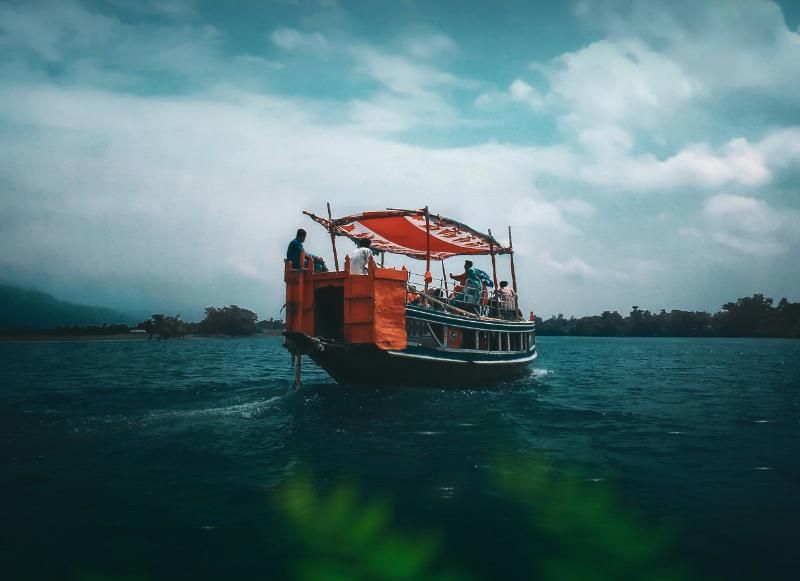
A fishing boat in the waters of Sylhet, Bangladesh. Image by Ebadur Rehman Kaium, Unsplash.
Bangladesh stands on the frontline of climate change. Home to more than 176 million people, an estimated 30 million are directly affected by or highly vulnerable to climate-related impacts. Despite contributing only around 0.3% of global fossil fuel emissions, the nation faces some of the world's most severe climate challenges, including devastating floods, cyclones, storm surges, erosion, and rising sea levels.
Recent events such as Cyclone Amphan, Cyclone Remal, and recurrent monsoon flooding across the country's river deltas continue to demonstrate the immense pressures facing coastal and inland communities.
As part of her visit, Professor Wiltshire travelled through surrounding waterways with local experts to gain first-hand insight into the realities of living in one of the world’s largest delta systems. Observing flood-prone landscapes and communities adapting to increasingly intense rainfall and changing environmental conditions reinforced the urgency of climate action.
“We can better understand what flooding, sea-level rise, and extreme rainfall mean for people and communities when we see these challenges with our own eyes,” she said. “The scale of adaptation required is enormous, but so too is the resilience and ingenuity of the people responding to these challenges every day.”
The visit also included engagement with innovative community programmes working alongside fishers and coastal residents to monitor environmental change and strengthen community resilience. These initiatives demonstrate how local knowledge and scientific research can work together to support sustainable coastal livelihoods.
Prof. Wiltshire is also supporting the Department of Oceanography in launching a new programme focused on low-cost environmental monitoring sensors. The initiative builds on international capacity-building efforts she helped establish during her tenure as Chair of the Partnership for Observation of the Global Ocean (POGO) and as Director of the Nippon Foundation–POGO Centre of Excellence in Oceanography. The programme aims to expand access to affordable monitoring technologies, enabling researchers and communities to collect critical environmental data and strengthen local observation networks.
Reflecting on the visit, Professor Wiltshire emphasised the importance of international scientific partnerships.
“Fostering international collaboration and creating opportunities to share knowledge across cultures is how we move climate science forward,” she said.
“I leave Bangladesh with deep appreciation for the warmth, professionalism, and scientific commitment of the colleagues and students I met. Their dedication gives me great optimism for the future of global ocean, climate, and sustainability research.”
Media Contact:
Thomas Deane | Media Relations | deaneth@tcd.ie | +353 1 896 4685