/filters:format(webp)/filters:quality(100)/prod01/channel_3/media/tcd/business/images/events/100-year/100-staff-photo.jpg)
Trinity Business School Centenary (1925 - 2025)
For a century, Trinity Business School has been shaping the future of business. Since 1925, we have developed forward-thinking leaders and produced research that influences practice in Ireland and globally. In 2025, we celebrated our centenary by honouring our past and looking ahead to the next 100 years.
/filters:format(webp)/filters:quality(100)/prod01/channel_3/media/tcd/business/images/events/100-year/John-Good.jpg)
What should a business school be? "It should be such a school as any graduate would feel pride in belonging to, and whose degree would carry with it a guarantee of knowledge and efficiency."
Founding supporter of Trinity’s School of Commerce (1925)
Trinity Business School 100-Year Kick-Off
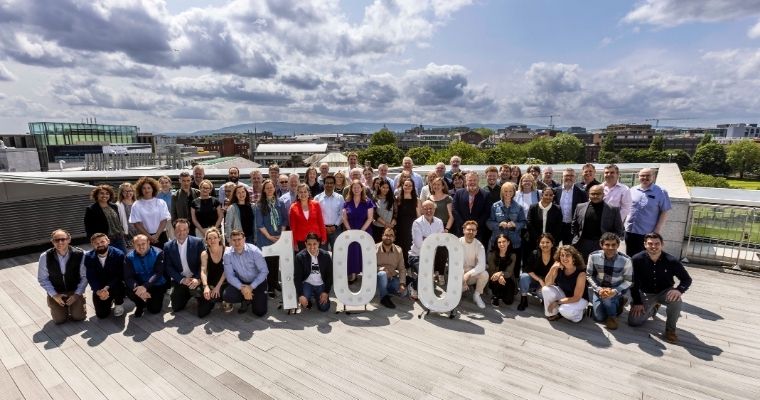
On 20 January 2025, the School united its community to form a giant "100" on the Rugby Pitch.
Events
Thank you to our students, staff, alumni, and partners for helping to make the centenary a truly memorable celebration from start to finish. Throughout 2025, we marked 100 years of business education at Trinity with a series of events celebrating our community, our history, and our ambitions for the future. Events included:
20 January 2025
We began our centenary celebrations with a powerful show of unity as students and staff assembled on the Trinity Rugby Pitch to form a giant “100”.
This memorable moment honoured the generations who have shaped Trinity Business School over the past century and celebrated the vibrant community leading us into the future.
27 January 2025
Our official centenary launch welcomed former President of Ireland, Dr Mary Robinson, to unveil the year-long programme of events.
Attended by students, alumni, faculty, donors and friends of the School, the launch marked 100 years of business education at Trinity. The day included a preview of our sustainability-driven campus landscaping and the announcement of our partnership with Pathways to Business, a Trinity Access initiative supporting underrepresented students in business education.
12 March 2025
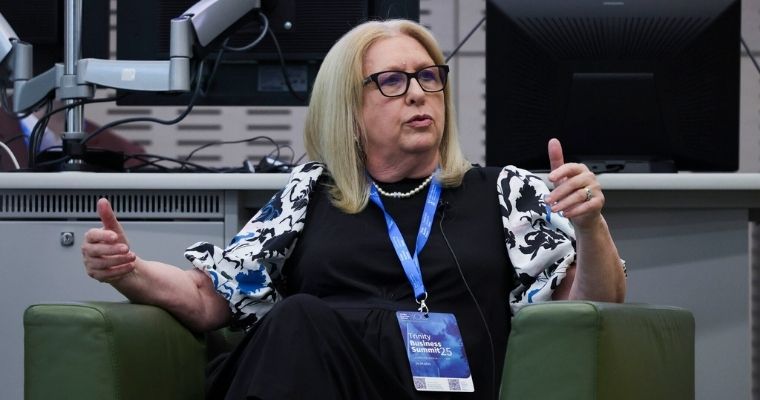
In collaboration with Trinity Sport, through a series of panel discussions we explored the parallels between elite sport and business leadership under the theme Leading for Good in Sport and Business.
Highlights included a keynote by Chancellor Mary McAleese and contributions from renowned figures across both fields such as Jamie Heaslip, Annalise Murphy, Joe McCarthy, and Benjamin Kayser.
We also celebrated Ireland’s Special Olympics athletes, Lorraine Whelan and Donal Brennan, who returned from the World Winter Games with an impressive medal collection. Panels were led by Trinity Business School faculty including Eimear Nolan, Andrew Burke, Sinéad Monaghan, David Collings and Wladislaw Rivkin.
20 May 2025
Alannah Weston, former Chairman of Selfridges Group and sustainability pioneer, joined us for a compelling keynote on purpose-driven leadership.
She shared insights from initiatives such as Project Ocean and Project Earth, and her experience hosting the podcast How to Lead a Sustainable Business. Alannah also spoke about her foundation’s support of the Weston Scholarships at Trinity, enabling MSc study in Responsible Business and Sustainability for underrepresented students.
26 June 2025
In this virtual discussion, Frank Sixt of CK Hutchison Holdings and Bill Cockrum, formerly of Becker Paribas Inc., examined shifting geopolitical landscapes and their influence on global markets.
Dean Laurent Muzellec provided a Trinity-focused response, reflecting on the implications for Ireland’s economic future and the evolving role of business education.
14 September 2025
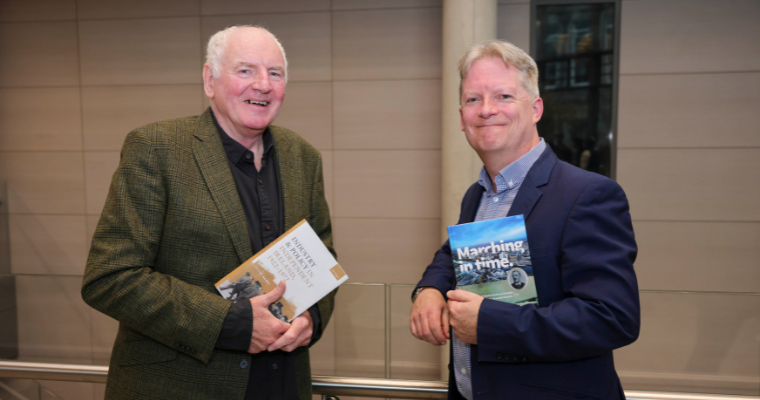
Marching in Time: 100 Years of Trinity Business School and Irish Economic Transformation is a special publication written by Dr Emmer Oliver, business historian, Trinity Business School lecturer, and economics writer. At the launch, Dr Emmet Oliver presented an overview of his new publication, and Professor Frank Barry shared insights on the development of the Irish economy, drawing on his extensive research in foreign direct investment and economic history.
The book is available to purchase at the Trinity Library Shop.
8 November 2025
Our Centenary Gala Dinner saw the Dargan Lecture Theatre transformed into a stunning dining room. Hosted in partnership with Trinity Business Alumni, the evening brought together 300 alumni, faculty, students, and friends for a night of reflection, connection,
and celebration. Guests enjoyed an orchestral reception performed by the Trinity Orchestra Society, followed by dinner accompanied by inspiring words from Dean Laurent Muzellec, Provost Linda Doyle, and Dr Gerard McHugh.
Highlights of the evening included the presentation of the Business Student of the Year 2025 Award to Meaghan Platt by Trinity Business Alumni President, Eithne Harley, a special message from Professor Andrew Burke to Bill Kingston, and the premiere screening of Trinity Business School: 100 Years, a film celebrating our proud legacy and vision for the future.
All proceeds from the evening supported the Pathways to Business initiative, helping to make business education more accessible for all.
13 November 2025
Centenary celebrations concluded with the installation of a Time Capsule, designed to preserve messages for future business leaders. It will remain sealed until 2075.
Created by Shane Holland, the sculpture titled Tempus Fugit (Latin for “time flies”) has been made almost entirely from recycled, found, or repurposed materials, reflecting our commitment to sustainability.
Inside, the capsule preserves 155 messages contributed by the graduating class of 2025, our current students, and our staff.
Now displayed on the foyer wall of Trinity Business School, the Time Capsule stands as a lasting symbol of reflection, creativity, and intergenerational connection. It serves as a reminder that although time flies, the values we share continue to endure.
Documentary: Trinity Business School at 100
In this short documentary commissioned by Dean Laurent Muzellec, academics, alumni, and students share the history of Trinity Business School and their vision for its future.
1925–2025 | Trinity Business School: A Century of Impact
Discover the milestones, achievements, and inspiring people who have shaped our journey over the past 100 years.
Centenary Book
A defining moment in our centenary journey with the launch of 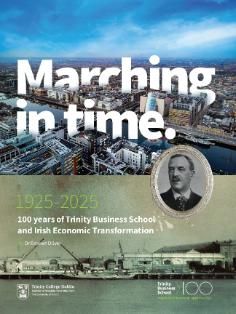 'Marching in Time: 100 Years of Trinity Business School and Irish Economic Transformation', authored by historian Dr Emmet Oliver. The publication charts the school’s evolution from modest beginnings with just 17 students in 1925 (when classes were only held in afternoons to accommodate the students’ work commitments) to the current enrolment of 2,800 students, from more than 60 countries.
The book is available to purchase at the Trinity Library Shop.
History: 100 Years of Transformation at Trinity Business School
1925–2025 | Trinity Business School: A Century of Impact
Discover the milestones, achievements, and inspiring people who have shaped our journey over the past 100 years. Join us in celebrating a century of innovation, leadership, and global impact.
Trinity Business School’s story begins with the founding of the School of Commerce in 1925, building on earlier experiments in business education dating back to 1906. Supported by the Dublin Chamber of Commerce, Trinity established one of the earliest university-based business schools in this part of the world, combining academic expertise with professional practice and offering programmes designed for working students. Over the decades, its curriculum evolved from commerce to modern business studies, marked by milestones such as the launch of one of Europe’s first MBA programmes in 1964 and continued growth in international outlook, research, and innovation. In recent years, the School has achieved global recognition through rankings, triple accreditation, new programme development, and the opening of its landmark near zero energy building in 2019. Today, Trinity Business School is guided by its ambition to Transform Business for Good, embedding sustainability, inclusion, and innovation at the heart of everything it does.
100 Year Celebration Gallery
Highlights from our centenary year celebrations.
.png)
.png)
.png)
.png)

.png)